Monday, 26 April 2010

Charging Black Rhinos

Black rhinos are formidable creatures, as I found out as I was tracking them in Zimbabwe.  I was part of a team of people mapping out the location of all the rhinos in the area.  Once mapped out, the de-horning team could fly in and efficiently dart all the rhinos and saw off their horns.  Sounds a painful process, but it is a bit like cutting your nails, the horn is made of keratin, the same stuff that your nails are made of.

So there I was in the middle of nowhere, with a tracker, facing a family unit of black rhino.  The male, which had a horn the size if the Eiffel Tower, knew that there was something up and was raised up on its haunches sniffing the air.  They are not that good at seeing things but boy are they good at smelling and hearing.  I held my breath for eternity as the male searched for the threat to his family.  The mother and the very very small calf were getting a bit agitated as well.  So we moved away from the family after recording data on each of the individuals. 

It was then that then that the wind changed and the male pin pointed us.  There was no hope but to run for it and climb the nearest tree.  The tracker, Ndomiso, was like lightening and up the tree before I considered moving.  And there I was, belting for my life as a ton of rhino bore down on me.  It was at that point that I realised that I could have climbed a greased telegraph pole with the amount of adrenalin that was coursing through me.  And I think I did as I do not remember getting into the tree but it was a long way down and I am not good with heights.  At least I had not been gored.

And that memory will stay for a lifetime, and what a great memory to have.

Thursday, 22 April 2010

Red-billed queleas - feathered locusts of Africa

I was going through some of my African facts with my friend Robbie Stevens, who is an excellent voice over artist by the way.  And one of the facts that he found fascinating was that red-billed queleas are the most abundant wild bird species and have an estimated adult bird population of 1.5 billion.  Thinking about it I find that too many to compute and we tried to imagine 1.5 billion, and failed. 

I have seen these birds in action when I was living in Zimbabwe. This enormous flock, that blotted out the sun, arrived and began nesting in the Save Valley Conservancy, thousands upon thousands of small finch sized birds making nests in any tree that they can find, the noise was deafening.  Vegetation from miles around was being stripped bare for nesting materials and seeds and flowering plants were being decimated for food.  It was an extraordinary spectacle.  They moved like locusts, leaving a wake of destruction as they crossed the savannah.  The Conservancy was hit hard as these marauders spent more time than usual in the area. 

But there were some species benefiting from this valuable food source, namely snakes and crocodiles.  There were snakes galore in the area feeding off chicks that had inadvertently fallen out of their nests and also eggs from within the nest.  But my most memorable experience was watching the crocodiles feeding on the quelea.  They would remain just under the surface of the water and when the quelea came down to drink the crocodiles would launch themselves out of the water and snap up any unsuspecting bird.  The crocodiles certainly got a few birds on each snap, but I wondered whether the energy used was worth the feathered popcorn bites that they got.

And then after a number of weeks this swarm of birds suddenly upt and left, leaving the African bush in a state of bewilderment from this feathered onslaught. What a remarkable species.

Monday, 12 April 2010

Ever had a Caracal sleep on your lap?

This last weekend I had time in my own flat, for once!  So I spent it lazing around like a cat, enjoying the sun, reading my books and watching the odd film.  Perrrfect.

I am not really a cat person but they do seem to like me.  Normal moggies seem to find my lap attractive, as do the not so normal ones - I have woken up to find a cheetah lying across my legs.  Admittedly it was a house trained one but my I had lost the feeling in my legs and the same cheetah had licked me on the face the previous night (which was quite painful).  But my most memorable experience was having a fully grown male caracal curl up and fall asleep in my lap.  Caracals are the cats with the very pointy ears and black ear tufts and have 20 different muscles in their ears which enables them to detect prey.

So here was this rare cat, snuggling on my lap without a care in the world.  Admittedly it had been brought in to be cared for as it had been injured, but it was going to be released back into the wild. Caracals are quite large cats to have sitting on your lap, it is commonly known as the Persian Lynx or African Lynx, despite the fact that it is not a lynx at all.  And I came to appreciate the size of it, the longer it sat on my lap. These cats are tenacious hunters and they have been known to bring down an ostrich, the fact that they can keep up with an ostrich is surprising in itself. The caracal mainly hunts rodents, birds (which it can catch in flight by leaping into the air), antelopes, gazelles and rabbits.  But this one was living the life or Riley by being hand fed impala.

A few days later my new friend was put into a large holding cage and after two weeks he no longer recognised me as he hissed at me from the back of the cage.  He was released back into the wild fully recovered, having completely forgotten about impala steaks, a secure bed and about me. 

A pretty adaptable creature.

Tuesday, 6 April 2010

Riding with Zebras

I was in the New Forest over the weekend and there were a lot of very wet and miserable looking donkeys, braying every now and again to show their displeasure in the weather.  I would have done the same as the rain was relentless.  The noise of the donkeys did take me back to Africa (the weather certainly did not!), as zebra calls are similar to that of donkeys.  But that is where the similarity ends.

Last time that I was in Zimbabwe I had an incredible experience of riding within a herd of zebra.  I was with a friend of mine who suggested that we went riding on her horses, just before my flight back to the UK.  I am not the best of riders but the idea of being out in the bush and seeing the wildlife from a zebra's perspective was an opportunity not to be missed.  We spent the morning wandering on horseback amongst herds of zebra which were unfazed by the presence of a human being - we were part of the horse and we were truly accepted into the herd.  I could smell the sweat of the zebras, hear the whinnying of the foals, watch them eating the foliage as I just sat at ease under the African sun as the world dawdled by.   At times we were so close to the zebras that I could count each individual eye lash.  A perfect end to a perfect trip.

Riding with zebras, better than walking with wet donkeys.

Monday, 29 March 2010

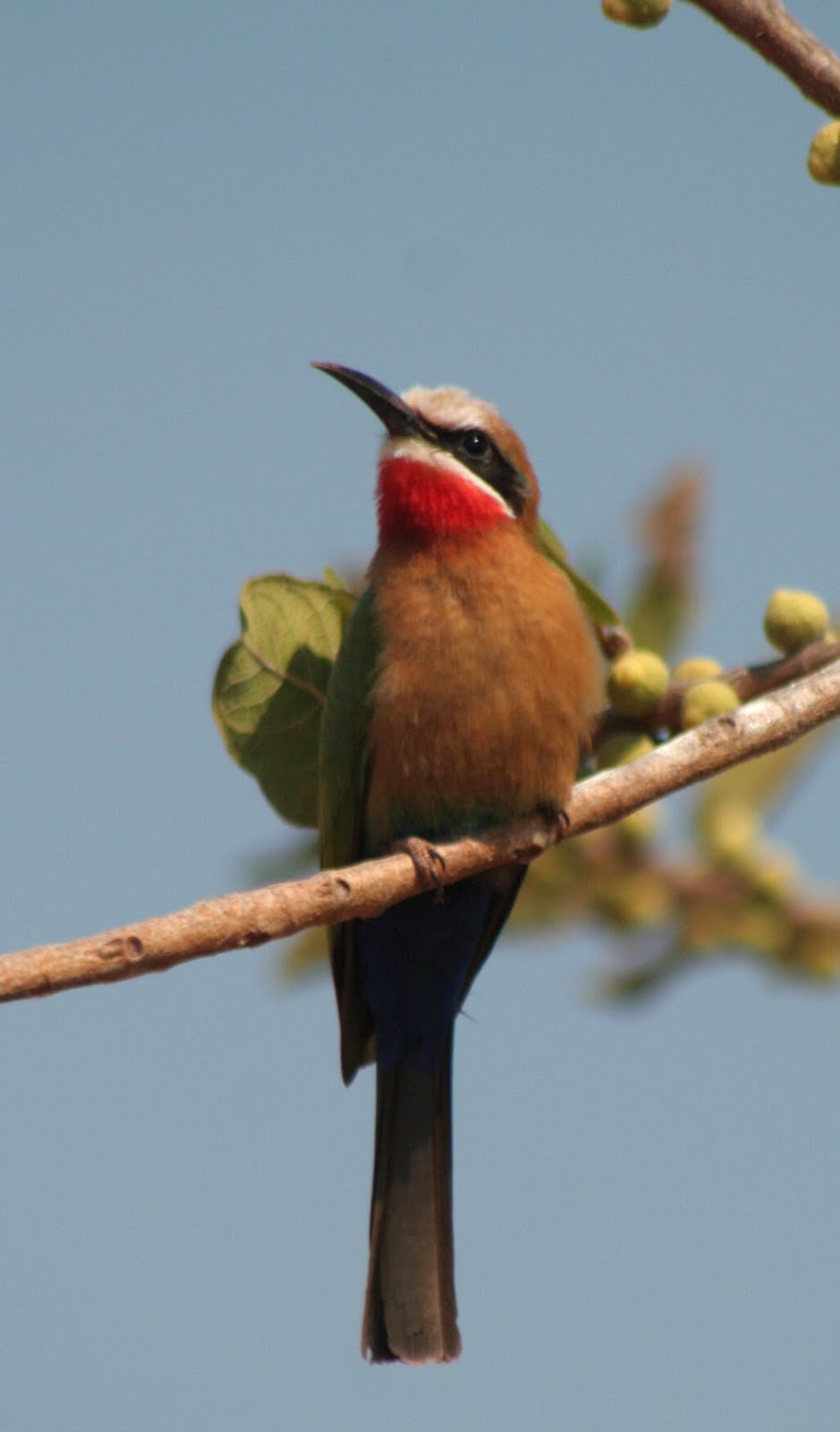
Unacceptable Bee-Eater Behaviour

White Fronted Bee-Eaters are reputed to have the most complex family based social system in the birding world.  Having watched these birds for hours on end in Mlilwane Wildlife Sanctuary, Swaziland, I am inclined to agree.

White Fronted Bee-Eaters live in large colonies where closely related birds help each other out.  A breeding pair will accept help from non-breeding birds in the form of digging the nesting chamber, feeding the female whilst she is sitting on her eggs, incubating the eggs themselves and even assisting in the upbringing of the fledglings.  Breeding pairs will accept the help of non-breeding birds, but only those which are most closely genetically related, thus building on family ties and ensuring the genetic continuation.  Rather dedicated family behaviour if you ask me and puts us humans to shame.

However, on the down side, non-breeding males will ambush breeding females and force them to the ground and rape them. The egg laying females may then create eggs related to the rapist and not the adult male that is caring for them.

Rather unacceptable behaviour really.

Friday, 26 March 2010

Ground Squirrel Ingenuity

I have just got back from the Lake District where I was amazed at how many signs there were stating that red squirrels were crossing the road, the signs were often accompanied by hazard markings.  I kept my eyes peeled for five days and did not see a single one, probably as it was raining and no self respecting squirrel would be seen in the rain, let alone near to an all singing, all dancing hazard sign.

This can not be said for the ground squirrel of Africa, which is a very cheeky chappie.  They are all singing and all dancing, well they have a high pitched whistle and can be pretty active during the cooler parts of the day.  Ground squirrels often live in colonies of up to 30 squirrels, living in a network of burrows under ground, which they often retreat to when it is hot.  The use of their tail is ingenious, it is used as an umbrella so that when these active creatures are out foraging for food they can have permanent shade.

Top that Mr Red Squirrel.

Monday, 15 March 2010

How To Track African Animals

I have just got back from delivering a talk on how to successfully track African animals in the bush, to a bunch of 5 year olds.  The challenge was not that they did not understand the difference between an antelope and a deer, or that an elephant weighs the equivalent of six short wheeled landrovers (6,000kg), the problem was trying to answer all the questions that were fired at me.  It was inspirational.  By the way, the height of an elephant is 2.5 times the circumference of the hind foot and there are four toes on the front foot and three on the back.

We went through various tracking techniques such as being quiet, remaining down wind of the animal you are following, looking for other signs of the animals you are tracking such as faeces, broken twigs, scraps in the ground and reading the movements of other nearby animals.  I then gave information about twelve African animals and presented the challenge to match up twelve footprints with the twelve animals.  Most of them got over half right, which was pretty impressive.  Why don't you pit your wits against them and see how good you are?  Are You An Ace Tracker?

And for those of you who are still wondering about the difference between an antelope and a deer - antelopes have horns which are permanent, whilst deer have antlers that are shed annually.